|
|
|
|
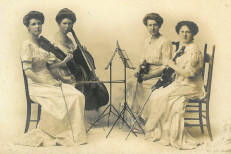
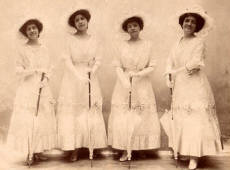
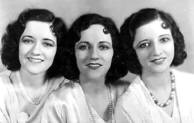
Altough all-female groups recorded on both disc and cylinder in the early 1900s (Olive Meade Quartet, Manhattan Ladies Quartet and Columbia Ladies Quartette all around 1912), male groups dominated the charts. The only exception was the "That Girl" Quartet's "Put Your Arms Around Me, Honey" and three other other songs on the charts between 1911 and 1913. They were the only all-female group to chart before before the Boswell Sisters, an all-white female group in 1931. The Boswells along with Bing Crosby's Rhythm Boys, virtually invented vocal group jazz stylings. Between 1931 and 1938, they placed 20 songs on the pop charts and were enormus influence on later female artists like Ella Fitzgerald and the Andrew Sisters.
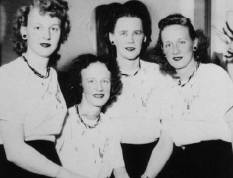
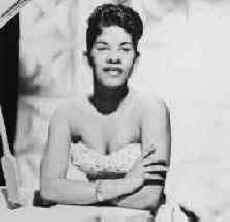
Johnson Sisters
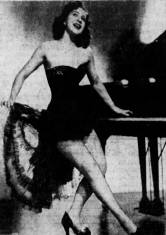
L: Ruby Johnson, circa 1941
The Johnson sisters from Chicago, began singing barbershop harmonies in the late 1920s and invaded the previously all-male barbershop world. By 1939 they had paved the way for thousands of female groups that would follow Their careers were firmly anchored in the 1930s.

Andrew Sisters
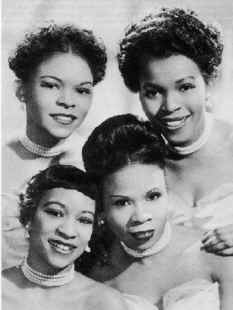
clockwise from top left:
Maxene Andrews, LaVerne Andrews and Patty Andrews, October 1943
The first of the modern female groups were the Andrew Sisters. Beginning in 1937 placed more than 100 songs on the pop charts in less than 15 years. Their songs ran from ethnic music, to bouncy patriotic songs like "Boogie Woogie Bulge Boy," to joint efforts with Bing Crosby, to jump tunes like "Don't Sit Underneath The Apple Tree with Anyone Else But Me." Though they had both feet planted in the pop style. They were photogenic and appeared in in more than twenty movies, many with patriotic themes. Most important, they broke the ice for female groups making it big in show business. Despite being white they reached a black audience appearing in the Rhythm & Blues charts three time in the mid 1940s. "Rum and Coca Cola" made the the first all-female group on Rhythm and Blues charts (January 1945).
The 1940s witnessed the beginning of a style wherein strong female leads would join with male groups and make the Rhythm & Blues charts fairly often. In some cases, the male group co-lead the song, as in "Cow Cow Boogie" by Ella Fitzgerald and the Ink Spots in 1944, or Little Esther and the Robins in "Double Crossin' Blues" in 1950. More commonly, a group was provided behind a female lead to produce a fuller sound. Ella Fitzgerald recorded songs back by the Four Keys, Ink Spots, Delta Rhythm Boys and even Ray Charles Singers. Savannah Churchill made a career for herself between the mid-40s and early 1950s by fronting the Four Tunes, the Striders and the Five Kings. Fitzgerald's tunes were pop-jazz rather than than within the scope of rhythm and blues, but Churchill's output was honest-to goodness late-40s Rhythm and Blue music. By making the Rhythm and Blue Chart they influenced the next generation of female Rhythm and Blues singers.
1948-1954
|
|
|
|
Female Lead with Male Group (1948-1954)
| Artist | Song | Year | Label |
Ella Fitzgerald/Delta Rhythm Boys |
It's Only A Paper Moon |
1945 |
Decca 23425 |
Savannah Churchill/Sentilmentalist |
I Want To Be Loved (But By Only You) |
1946 |
Manor 1046 |
Little Esther/Robins |
Double Crossin' Blues |
1950 |
Savoy 731 |
Ruth Brown/Delta Rhythm Boys |
Sentimental Journey |
1950 |
Atlantic 905 |
Dinah Washington/Ravens |
Out In The Cold Again |
1951 |
Mercury 8257 |
Viola Watkins/Crows |
Seven Lonely Days |
1953 |
Rama 3 |

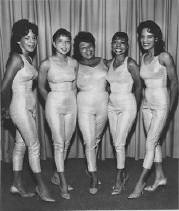
Shirley
Gunter and the Queens
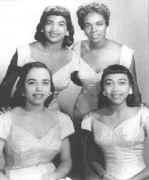
Clockwise from top left)
Blondean Taylor, Lula Mae Suggs, Lula Kinney (Piper Alvez) and
Shirley Gunter
Women in groups and single artists virtually disappeared from the Rhythm and Blues charts for about six years. From July of 1948, when Savannah Churchill backed by the Four Tunes charted with "I Want To Cry," to October 1954, when Oop Shoop" by Shirley Gunter and the Queens hit, only three records featuring women appeared on the Rhythm and Blues chart. Two were pop songs by Ella Fitzgerald backed by groups, the other "Double Crossin' Blues" by the Robins with Little Esther (February 1950).
Little Esther besides charting with the Robins, also did "Other Lips," and "Heart To Heart" in 1951 with Clyde McPhatter and the Dominoes. Savannah Churchill did "Let's Call A Spade A Spade" (1947, Five Kings,) "Can Anyone Explain" (1950, Four Tunes) and "Once There Lived A Fool" (1950, Striders). Ruth Brown with the Rhythm Boys did "Sentimental Journey" and "All In Your Mind" in 1950 and Ann Nichols with the Bluebirds did "Those Magic Words", also in 1950. Dinah Washington and the Ravens did the first rhythm and blues version of "Out In The Cold Again," in 1951. In 1952 Lil Greenwood, Shirley Haven and Cora Williams did blues type recordings with the Four Jacks. In 1952 Viola Watkins did "Seven Lonely Days" with the Crows.
|
|
During this time all-female groups were recording too. Della Griffin and the Enchanters, who later became the Delltones, recorded "How Could You" and "I'm Lost" in 1951-1952.
From July, 1948 when Savannah Churchill backed by the Four Tunes charted with "I Want To Cry" until October, 1954 Shirley Gunter and the Queens charted "Oop Shoop," only three records by women appeared on the R&B chart. Those two were by Ella Fitzgerald and other by Little Esther with the Robins "Double Crossin' Blues" February, 1950.
Little Esther also did "Other Lips, Other Arms" and "Heart To Heart" (1951) with Clyde McPhatter, Savannah Churchill recorded "Let's Call A Spade A Spade" (1947, Five Kings), "Can Anyone Explain" (1950, Four Tunes) and "Once There Lived A Fool" (1950, Striders). Ruth Brown with the Delta Rhythm Boys did "Sentimental Journey" and "It's All In Your Mind" and Ann Nichols with the Bluebirds who later became the Robins.
1954-1957
The groups chosen above were based on they having made Billboards R&B chart
All Female Groups (1954-1957)
| Artist |
Song |
Year |
Label |
Shirley Gunter and the Queens |
Oop Shoop |
1954 |
Flair 1050 |
Etta James and the Peaches |
The Wallflower |
1955 |
Modern 947 |
Hearts |
Lonely Nights |
1955 |
Baton 208 |
Bonnie Sisters |
Cry Baby |
1956 |
Rainbow 328 |
Cookies |
In Paradise |
1956 |
Atlantic 1084 |
Joytones |
My Foolish Heart |
1957 |
Rama 215 |
Deltairs |
Lullabye Of The Bells |
1957 |
Ivy 101 |
Rosebuds |
Dearest Darling |
1957 | Gee 1033 |
Shepherd Sisters |
Alone |
1957 |
Lance 125 |
Starting with all-female groups there's Shirley Gunter and the Queens, the (West Coast) Dreamers, Etta James and the Peaches, the Cookies, the Miller Sisters, Deltairs, Joytones, Rosebuds and the Hearts. You might also add the Bonnie Sisters, Chordettes, Shepherd Sisters and Poni-Tails.
If you pass on the Enchanters and River Rovers because of their obscurity, then Shirley Gunter and the Queens qualifies as the first all female R&B group. They made the charts near the end 1954 with "Oop Shoop" followed by "You're Mine."
The Dreamers didn't have any big hits, but had modest success on the West Coast when they backed Richard Berry on "Bye Bye" in 1954. They are better known when they became the Blossoms and changed members to include Dalene Love. Etta James prefaced her three-decade solo carerr by recording "The Wallflower" with the Peaches in February 1955. The record was also called "Roll With Me Henry."
The Hearts were arguably the premier female group of the 1954-1957. Their first release on Baton, "Lonely Nights," made the R&B charts
The Cookies featuring Earl-Jean McCrea evolved into Ray Charles' back-up group the Raeletts. In March 1956 they charted R&B with "In Paradise." They had big hits R&B and pop with "Chains" (December 1962) and "Don't Say Nothin' Bad (About My Baby)" (March 1962). The Miller Sisters never had any big hits, but made up for it by issuing roughly 20 singles from 1955 through the early 1960s. The Joytones had "My Foolish Heart" in 1956.
1958-1964
 Jaynetts |
 Jelly Beans |
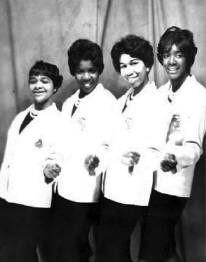 Jewels |
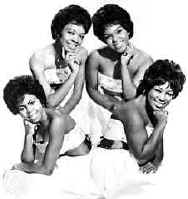 Shirelles |
 Sherrys |
The groups chosen above were based on their having made Billboard's R&B chart.
In 1954 the girl groups moved away from R&B to a doo wopish sound in the style of thedistaff and tin pan alley subcategories of Distaff Doo-Wop and Tin Pan Alley Doo-Wop.
Distaff-doo-wop refers to to the contributions of females to the body of doo-wop works. Earlier contributions were made by Shirley Gunter and the Queens, the Bobbettes, Tonettes, Chantels and Shirelles. On occasions woman lead singers fronted male groups, Zola Taylor with the Platters, Pat Spann the Cleftones and Barbara Lee with the Aquatones. With these few exceptions, women did not play a prominent role in doo wop until the 1962-1963 Neo-Doo Wop and Tin Pan Alley sound grew in favor.
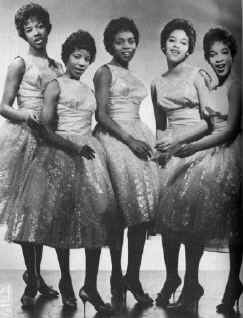
The rise of the Girl Group Sound really began in 1961.The candidate as originator of the sound were the Shirelles. Starting in October 1960, and continuing through the end of 1964, the group had an almost uninterupted string of chart hits. They began in in 1958 with "I Met Him On A Sunday"and releasing "Dedicated To The One I Love" in 1959. They made their first Top 40 hit at the end of 1960 with "Tonight's The Night," reaching #14 R&B and #39 Pop.
Next came "Will You Love Me Tomorrow" which charted in December 1960 and stayed on the charts for three months, making #1 Pop and #2 R&B. February 1961 "Dedicated To the One I Love" was reissued reaching #2 R&B and $3 Pop. In May 1961 "Mama Said" followed reaching #2 R&B and #4 Pop. "Baby It's You" in January 1962 went #3 R&B and #6 Pop and in March 1963 "Soldier Boy" reached #1 Pop, #3 R&B.
Beginning in the late 1959s, a new group of young songwriters entered the market. These young men and women had been exposed to early and mid-50s doo-wop, rhythm and blues and rock 'n' roll, yet often studied music theory and classical music while growing up. They developed their own ideas about what the music of the early 60s should sound like. These ideas were new and radical. Songwriting teams of Gerry Goffin and Carole King, Barry Mann and Cynthia Weil, and Jeff Barry and Ellie Greenwich, and producers like Phil Spector and the Tokens became hitmakers.
The Girl Group Sound usually blended doo-wop characteristics of light harmony, bass and nonsense symbols with more complex melodies, more instrumentation (spector's Wall of Sound) and painstaking production practices. The voices were young, strong and innocent and the melodies hummable.
The Girl Group Sound after 1960, were carefully planned to sound a certain way, the sounds of many groups were interchangeable. The subject matter was of simple joy, innocence, sex, life itself, but most often it was a celebration of The Boy.
The Girl Group Sound took over the charts from 1962-1964. 15% of the records that charted were by female groups or had a female lead. This increased to 22% in 1962, then to 55% in 1963, and finally 57% in 1964. After 1964 the female groups that charted drastically dropped because they didn't sing in the doo-wop style (e.g. Supremes, Shangri-Las).