Raindrops
Ellie Greenwich, Jeff Barry, Laura
Greenwich
The Raindrops existed for one reason only. That was to sing songs
written by Jeff Barry and Ellie Greenwich, successful
songwriters from Leiber-Stollers Trio Music in the Brill
Building.The Raindrops are, on one level, little more than a
footnote in the much broader musical careers of Ellie Greenwich
and Jeff Barry. On the other hand, as a studio singing group,
they assembled one of the more impressive bodies of popular vocal
music of the early '60s to come out of the Brill Building, the
early '60s successor to Tin Pan Alley of the 1920s, which also
served as proving grounds for the likes of Phil Spector, Don
Kirschner, and numerous other luminaries of American pop-rock.
Members (1963-1965):
Jeffy Barry
Ellie Greenwich
Laura Greenwich
Jeff Barry
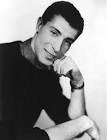
Jeff Barry (b. Jeffrey Adelberg, April 3, 1939,
Brooklyn, New York) and Ellie Greenwich (b. Oct. 23, 1940,
Brooklyn) were from two families related by marriage, and first
met at a family gathering in 1944 when they were age five and
four, respectively.
Berry's family moved to Newark, New Jersey where he listened
to Country and Western; writing his first song "I Gotta Gun,
I Gotta Pony, I Gotta Sweetheart Too" at the age of seven.
Greenwich's family moved to Levittown, Long Island where she
began writing songs in junior high school even as she studied
music, and led a girl trio called the Jivettes while still in
high school --Greenwich's instrument at the time was the
accordion.
Barry graduated from Erasmus Hall High School in 1955, put in
some army service, and afterward attended City College in
Manhattan. In 1959 Adeberg recorded his first record "Hip
Couple" for RCA Records under his self-created professional
name Jeff Barry. Meanwhile, Ellie Greenwich, a student at Holstra
University, released her very first commercial recording in 1958
(under the name Ellie Gaye), entitled
"Cha-Cha-Charming," on RCA. Neither of their records
sold well.
Barry entered the music business in a more successful manner
in 1959 as a songwriter working for E.B. Marks Publishers.
Barry and Greenwich met once again at a Thanksgiving dinner in
1959 at Greenwich's aunt's house. Barry was married at the time.
Barry's first chart hit was "Teenage Sonata" by Sam
Cooke. The big success came along the next year Top Ten pop
hit "Tell Laura I Love Her," one of the most
haunting and notorious of the teenage "death songs"
that became popular in the early '60s. Ray Peterson scored a huge
hit with it that year. As his marriage began to crumble, Barry
began including Greenwich in his activities, paying her $15 a
session to record some demos of his songs. By the end of the
1960, Barry was divorced, and he and Greenwich began dating,
writing, and recording demos together at the Brill Building,
where Barry's publisher employer was based. A few more of Barry's
records were released, as were Greenwich records credited to
Ellie Gee and Kellie Douglas. None of them sold.
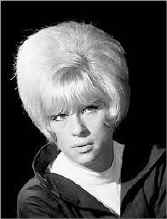
Ellie Greenwich
Greenwich graduated Hofstra and auditioned for a
staff writing position with Lieber and Stoller. They hired her
for Trio Records for $100 a week. In collaboration with writers
like Ben Raleigh and Tony Powers, Greenwich got a half dozen of
her songs recorded. Meanwhile, Barry recorded as a singer with
several groups, including the Redwoods for Epic Records and the
Spartans for Web Records.
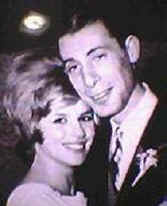
Wedding picture
Their marital partnership began on October 28, 1962, but their
songwriting partnership had to wait, as each was signed to a
different publishing company. They finally linked up in business
a year later, and spent much of that time collaborating with Phil
Spector on such songs as "Da Doo Ron Ron," "Then
He Kissed Me," "Be My Baby," and "Baby I Love
You."
They began recording together commercially with
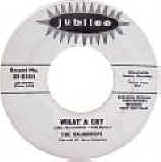
"What A Guy," a song originally intended for a vocal
group called the Sensations. Their demo was considered so good
that the record company, Jubilee, decided to release it, and
chose to credit it to "The Raindrops." The demo got to
No. 41 on the charts, considered a respectable beginning in those
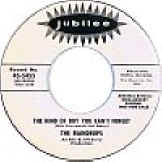
days, especially for a non-existent group. The next Raindrops
single, "The Kind of Boy You Can't Forget," got to No.
17, an unabashed hit
.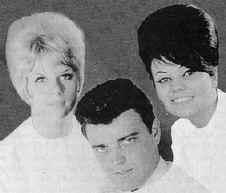
Publicity picture
(R-L) Ellie Greenwich, Bobby Bosco, Beverly Warren
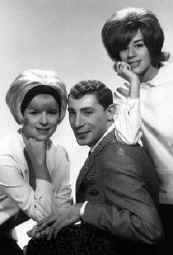
Now there was demand for the Raindrops, including
publicity stills. The photos that were issued featured Barry and
Greenwich, and Ellie's younger sister Laura, who otherwise had
nothing to do with the group whatsoever. Personal appearances
were rare, although they did occur, with Ellie and demo singer
Beverly Warren), miming to a dead microphone, with Barry replaced
by Bobby Bosco.
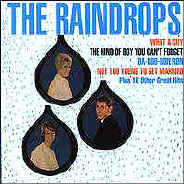
The Raindrops LP was issued by Jubilee in late
1963, which mostly consisted of the best Barry-Greenwich demos
punched up with extra overdubbed vocals, including "Da Doo
Ron Ron," "When The Boy's Happy (The Girl's Happy
Too)," "Hanky Panky," and "I Won't Cry."
The album's release was accompanied by a third single, "That
Boy John," which might've been a hit but for the fact that
it barely had a chance to get any airplay before President John
Kennedy was assassinated in November of 1963.
None of the Raindrops' remaining recordings fared any better,
partly owing to the fact that they were inevitably competing with
other groups on their best material. The arrival of the Beatles
in 1964 heralded a wave of British acts that not only had a more
powerful sound (most of those groups were self-contained, and
almost all had pretty extensive performing credentials) that
teenagers wanted, but could do great covers of Barry-Greenwich
songs themselves. Manfred Mann's version of "Doo Wah
Diddy" is the most well known, a huge international hit, but
other bands, including the original Moody Blues ("I Have A
Dream") plundered their song book. The Raindrops' sound
turned out to be a little too rooted in the pre-Beatles past, a
kiss-of-death in those days.
The Raindrops simply ceased activity, although Barry and
Greenwich continued to enjoy hits as songwriters, their real
professions in any case. Their most visible work was in
association with producer George "Shadow" Morton and
the girl group the Shangri-Las ("Remember,"
"Leader of the Pack," "Out In The Streets")
and Phil Spector ("River Deep, Mountain High"), who was
the only American producer who seemingly managed to bridge the
gap between the two eras of pop music.
"Jeff and I lasted as a writing team
about as long as we lasted as a married team - a little less than
five years. We tried to write together right after the split up,
but it was awful. We couldn't sit and write "Baby, I Love
You" with divorce papers sitting right next to us"
Ellie Greenwich in Off the Record
The couple's marriage ended in late 1966,
although they continued to write songs together on a less
frequent basis. Although Barry and Greenwich continued to
see success as songwriters into the late '60s and beyond, they
would never regain even a chance at the spotlight that they'd had
a decade earlier.
In 1973, Verve Records attempted to record Ellie Greenwich in
a sort of Carole King mode with Let It Be Written, Let It Be
Sung, but the chemistry just wasn't there, and the album was
never more than a cult favorite among serious pop listeners.
One of the last projects that Barry and Greenwich collaborated
on as writer/and producers was The Meantime, a revival of
The Raindrops. Their single came out on Atco Records in 1967, to
little success. Ellie attempted to and establish herself as a
solo singer. A few singles and albums were released. Thereafter,
she turned to writing and singing jingles. Clarence Clemons and
Ellen Foley have recorded some of her newer songs and she
occasionally did back-up vocals. In the mid-80s, Greenwich was
the subject of the Broadway play Leader of the Pack.
Behind the scenes, she formed Hook, Line and Sinker, a jingle
company to write/produce/sing commercials for Clairol, Revlon,
McDonald's and Hebrew National Hot Dogs.
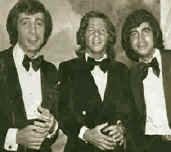
L to R: Jeff Barry, Ron Dante, and Andy Kim
Berry went on to produce hits for the Monkees and the
Archies, producing all of the latter's 45's and albums. Berry
went on to head Steel Records, producing and sometimes writing
for Illusion, Andy Kim and Robin McNamara; to co-write/produce
Bobby Bloom's "Montego Bay," numerous sides for
the persuasions, John Travolta, and the sound track to The
Idolmaker (1980). Barry is now in semi-retirement in
Bel-Air, California.
In May 1991, Ellie Greenwich and Jeff Barry were inducted in the
same ceremony into the Songwriters' Hall of Fame, in recognition
of a pair of careers that have spanned the 1950s to the 1990s.
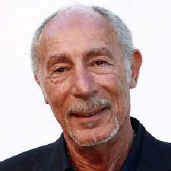
Jeff Barry today
Ellie Greenwich and Jeff Barry were inducted into
the Rock
and Roll Hall of Fame in 2010.
Ellie Greenwich died August 26, 2009 of a heart attack
at St. Lukes Hospital, New York City, where she had been admitted
a few days earlier for treatment of pneumonia, she was 69.
Ellie
Greenwich
The
Raindrops